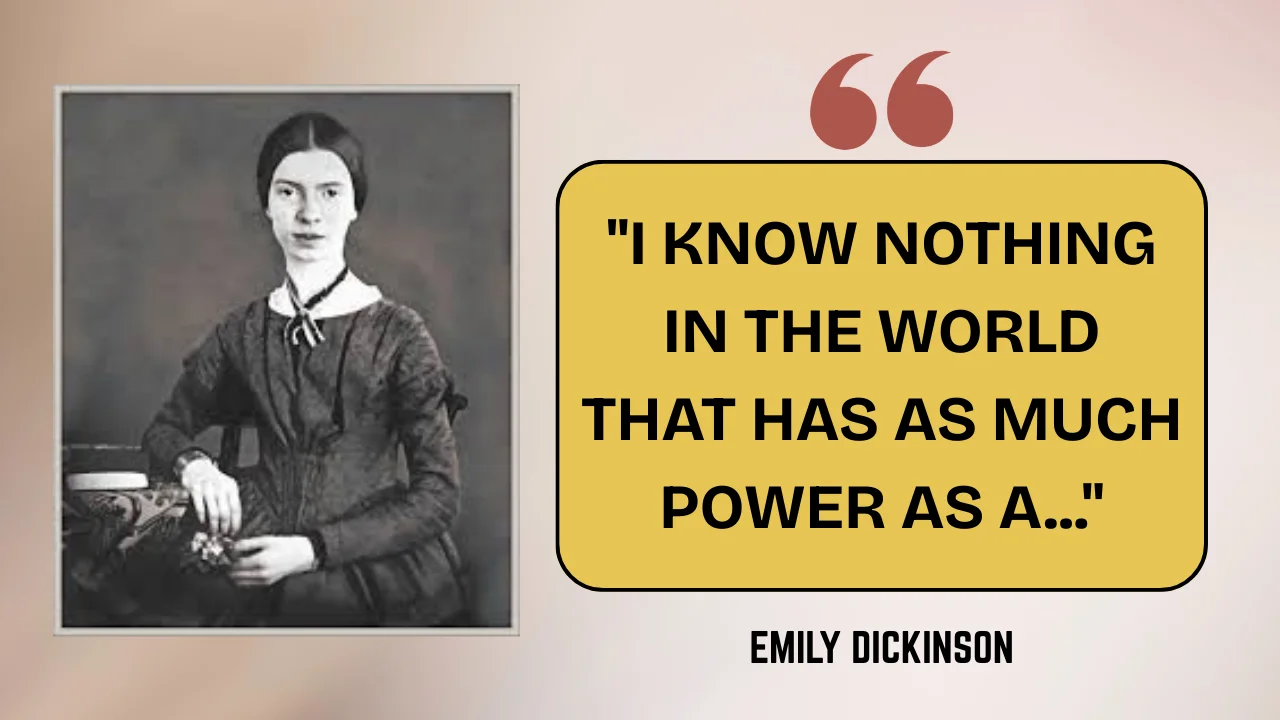
Quote of the Day by Emily Dickinson: Quote of the Day by Emily Dickinson reminds us that words are far more powerful than we often realize. In everyday life people speak thousands of words, send countless messages, and read endless content online. Yet very few words truly stay with us. That is why the message behind the Quote of the Day by Emily Dickinson feels so meaningful even today. She believed that language carries emotion, thought, and influence that can shape the way people understand life.
The Quote of the Day by Emily Dickinson speaks about the power of a single word. According to her famous line, nothing in the world has as much power as a word because language can inspire hope, express truth, and transform ideas into reality. This article explores the meaning of this quote, the life of Emily Dickinson, her unique writing style, and the reason her words continue to inspire readers across generations.
Quote of the Day by Emily Dickinson
The Quote of the Day by Emily Dickinson highlights how deeply she respected the power of language. She once wrote, “I know nothing in the world that has as much power as a word. Sometimes I write one, and I look at it, until it begins to shine.” This statement reflects her careful approach to writing. Dickinson did not treat words casually. For her, every word carried weight, emotion, and meaning.
In the context of literature and modern communication, the Quote of the Day by Emily Dickinson reminds readers that thoughtful language matters. Words can motivate people, comfort someone in pain, or express feelings that are difficult to describe. Her belief was simple but profound. When a writer chooses the right word, that word can stay with readers for a lifetime. This idea also explains why her poems are short yet deeply powerful.
Overview Table
| Topic | Details |
| Full Name | Emily Elizabeth Dickinson |
| Birth Date | December 10, 1830 |
| Birthplace | Amherst, Massachusetts, United States |
| Profession | Poet |
| Total Poems Written | Nearly 1,800 poems |
| Recognition | Became widely famous after her death |
| Writing Style | Short lines, unusual punctuation, deep symbolism |
| Major Themes | Nature, love, death, faith, identity |
| Famous Quote | “I know nothing in the world that has as much power as a word.” |
| Literary Influence | Considered one of the most influential American poets |
Early Life of Emily Dickinson
Emily Dickinson was born in the quiet town of Amherst, Massachusetts. Her father, Edward Dickinson, was a lawyer and a respected public figure who was involved in politics and community affairs. Her family believed strongly in education and moral responsibility.
Emily attended Amherst Academy where she studied a wide range of subjects including literature, science, and classical languages. Later she joined Mount Holyoke Female Seminary for further education. During her school years she developed a deep interest in reading and writing. Her curiosity and independent thinking were visible even in her early life.
Although she grew up in a socially active family, Emily preferred a thoughtful and observant lifestyle. These personal traits later influenced her poetic voice and creative imagination.

A Life of Quiet Creativity
As Dickinson grew older she slowly withdrew from public gatherings and social life. By her thirties she rarely stepped outside her family home. Many people in the town knew her as a mysterious yet gentle person who lived quietly.
She often communicated with visitors through letters or short conversations from behind a partially opened door. Her habit of wearing white dresses frequently earned her the nickname “The Woman in White.”
However, her quiet lifestyle did not mean inactivity. Inside her home she spent countless hours writing poetry. This solitude gave her the mental space to explore emotions, philosophy, and nature through words.
Her Works- a private revolution
When Emily Dickinson died in 1886, very few people realized the extent of her literary work. Only a small number of her poems had been published while she was alive, and even those were edited heavily to match the poetic standards of that time.
After her death, her sister Lavinia discovered nearly 1,800 poems carefully organized in small handwritten booklets known as fascicles. This discovery shocked the literary world.
Dickinson’s poetry was very different from traditional nineteenth century poetry. Instead of long decorative verses she used compact lines and sharp imagery.
Some distinctive features of her poems include:

- Short and concentrated lines
- Slant rhyme rather than perfect rhyme
- Unconventional use of capital letters
- Frequent dashes used as pauses
- Sudden shifts in thought or perspective
These elements created a style that felt both personal and revolutionary.
Her style
Emily Dickinson’s style may appear simple at first glance, but it carries extraordinary depth. Many of her poems contain only a few lines, yet each word feels carefully selected.
She often used hymn meter, a rhythmic structure commonly found in church hymns. This familiar rhythm made her poems feel musical and easy to read, even when the subject matter was complex.
One of her most distinctive techniques was her use of pauses and punctuation. Instead of traditional sentence flow, Dickinson allowed thoughts to break and shift. This approach invites readers to pause and think deeply about each phrase.
The philosophy behind the Quote of the Day by Emily Dickinson reflects this writing style. Because her poems were brief, every word needed to shine with meaning.
The impact
Although Emily Dickinson received little recognition during her lifetime, her influence on modern poetry is immense. After her poems were published, critics and writers realized that her work had transformed poetic expression.
Many twentieth century poets admired her precision and emotional depth. Her ability to express large ideas in very few words inspired later literary movements.

Her influence can be seen in several ways:
- Encouraging concise and powerful poetry
- Inspiring free verse writing
- Promoting introspection and emotional honesty in literature
The enduring popularity of the Quote of the Day by Emily Dickinson also shows how timeless her ideas remain.
Who was Emily Dickinson, really?
Many people imagine Emily Dickinson as a lonely and isolated figure. While she certainly valued solitude, her life was more complex than that image suggests.
She maintained thoughtful relationships through letters and correspondence with friends, mentors, and family members. She read widely and kept up with intellectual discussions of her time.
Nature also played an important role in her daily life. Dickinson loved gardening and spent time observing flowers and seasonal changes. These observations often appeared in her poetry.
Her famous line about the power of language shows that she believed the human mind and imagination could be larger than the physical world.
Quote of the day
The Quote of the Day by Emily Dickinson captures the heart of her philosophy about language. She believed that words are not just symbols on paper. They shape how people experience reality.

A word can comfort someone who is grieving. A word can inspire courage in difficult moments. A word can also spark movements, ideas, and creative expression.
Dickinson practiced what many modern writers call linguistic precision. Instead of writing many unnecessary lines, she focused on a few carefully chosen words.
This is why the Quote of the Day by Emily Dickinson continues to resonate with readers today. In an era filled with constant information and digital communication, her reminder about thoughtful language feels more important than ever.
Why she still matters
In the modern digital world people encounter an overwhelming amount of information every day. Social media posts, articles, and online discussions produce endless streams of words.
Yet the lesson behind the Quote of the Day by Emily Dickinson remains powerful. Words matter most when they are chosen carefully and used with intention.
Dickinson teaches readers to slow down and appreciate the depth of language. Her poems prove that a few well chosen words can hold immense meaning.
For students, writers, and literature lovers, her work continues to serve as a reminder that language is one of the most powerful tools human beings possess.

FAQs
What is the meaning of the Quote of the Day by Emily Dickinson?
The quote means that words have great influence. They shape thoughts, emotions, and understanding. Dickinson believed that a carefully chosen word can have lasting impact.
Why is Emily Dickinson important in literature?
Emily Dickinson is considered one of the most influential American poets because of her unique style, deep themes, and innovative use of language.
How many poems did Emily Dickinson write?
She wrote nearly 1,800 poems during her lifetime, though only a small number were published before her death.
What themes appear in Emily Dickinson’s poetry?
Her poetry often explores themes such as death, nature, hope, faith, identity, and human emotions.
Why is the Quote of the Day by Emily Dickinson still relevant today?
The quote reminds people that words shape communication and understanding. In the modern digital age thoughtful language remains extremely important.